PAYE, KiwiSaver, ACC levies, Holidays Act calculations… New Zealand’s payroll obligations are more complex than most business owners realise. Here’s what you need to get right, and what happens when things go wrong.
A produce distribution business had three employees, paid in cash, with no PAYE registered and no records kept. No deductions, no filings, nothing. When the IRD investigated, the owner admitted he knew exactly what his obligations were. The result wasn’t a fine or a warning, it was a criminal prosecution and a jail sentence.
That’s an extreme case. But the underlying lesson isn’t. Payroll compliance in New Zealand carries real legal weight, and the gap between “we’ve been doing it this way for years” and “we’ve been doing it wrong for years” is where penalties, investigations, and remediation costs live.
The essentials: What every employer needs to manage
As an employer, you’re required to deduct PAYE from every salary and wage payment you make, and that’s just the start. A compliant payroll also needs to correctly handle:
- ACC earners’ levies
- KiwiSaver contributions (both employee deductions and employer contributions)
- Student loan repayments
- Leave entitlements under the Holidays Act (annual leave, sick leave, and public holidays)
- Employer Superannuation Contribution Tax (ESCT)
- Child support deductions where applicable
Each of these has its own rules, rates, and edge cases. And all of them change over time, which means staying current isn’t a one-off exercise, it’s an ongoing one.
Filing: The dates that matter
Every time you pay your employees, you’re required to file employment information with the IRD. Not monthly. Not quarterly. Every. Single. Payday.
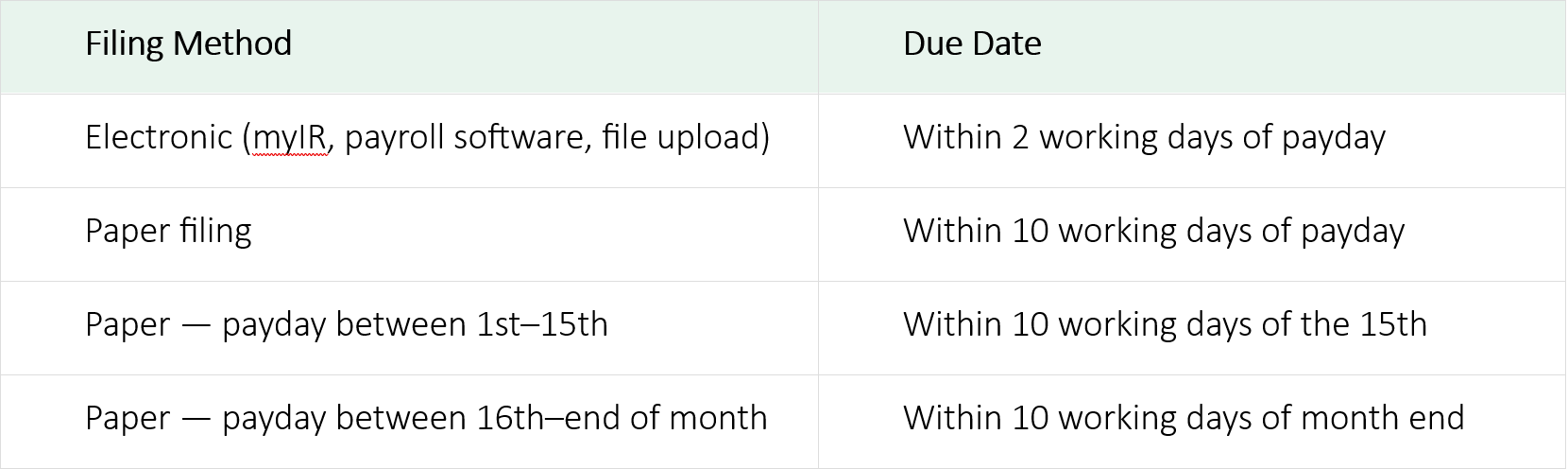
New employers get a six-month grace period to file electronically or by paper. After that, if your total annual PAYE and ESCT is $50,000 or more, electronic filing is compulsory.
PAYE payments: Know your category
Small to medium employers (annual PAYE and ESCT under $500,000): pay monthly, by the 20th of the following month.
Large employers (annual PAYE and ESCT $500,000 or more): pay twice a month. Wages paid 1st–15th are due by the 20th of that month. Wages paid 16th–end of month are due by the 5th of the following month.
You can always pay more frequently than required. You can’t pay less.
Records you're legally required to keep (for seven years)
This isn’t optional paperwork, these records are a legal requirement:
- Time and wages information, including leave entitlements
- PAYE calculations and payment records
- Tax code declaration forms for all employees and contractors
- IRD correspondence on tax code changes
- Employment agreements
- KiwiSaver forms
- Certificates of exemption, tailored tax codes, and tailored tax rate certificates
Seven years is a long time. The good news is that most payroll software handles record-keeping automatically, but only if it’s set up correctly in the first place.
The errors that get businesses into trouble
IRD investigations don’t usually start with fraud. They start with patterns of small errors that add up to a big problem.
Here are the most common payroll mistakes we see, and that the IRD tends to find:
- Incorrect tax codes applied to employees
- Failing to deduct PAYE, KiwiSaver, or student loan repayments
- Missing payday filing deadlines
- Late PAYE payments (these attract both penalties and interest)
- Incorrect KiwiSaver contribution rates
- Missing or inaccurate employee start and finish dates
- Errors in Holidays Act calculations (this one deserves its own section)
The Holidays Act: an ongoing compliance challenge
Annual leave calculations under the Holidays Act are genuinely complex, and errors are widespread, particularly in businesses with variable hours, shift workers, or commission-based pay structures.
The consequences aren’t just a correction. They’re remediation payments to every affected employee, past and present, plus the time and cost of tracking them down and quantifying what’s owed. Health NZ (formerly District Health Boards) has been making large-scale remediation payments since 2025 and is still working through them. This isn’t a small-business-only risk, it’s caught some of New Zealand’s largest organisations.
A smarter option: Payroll intermediaries
If managing all of this internally feels like a lot, well, it is. One practical solution is engaging an IRD-approved payroll intermediary. Under this arrangement, the intermediary takes on responsibility for:
- Correct calculations and deductions
- Payday filing with the IRD
- Payments to both employees and IRD
- Accurate record-keeping
Your job becomes providing accurate wage information and ensuring funds are available. That’s a significant reduction in complexity and risk, and it means someone who does this every day is accountable for getting it right.
Not sure if your payroll is fully compliant?
Let’s take a look together. A payroll review now is considerably cheaper than an IRD investigation later, and we know exactly what to check. Give us a call and we’ll set up a time.
.jpeg)